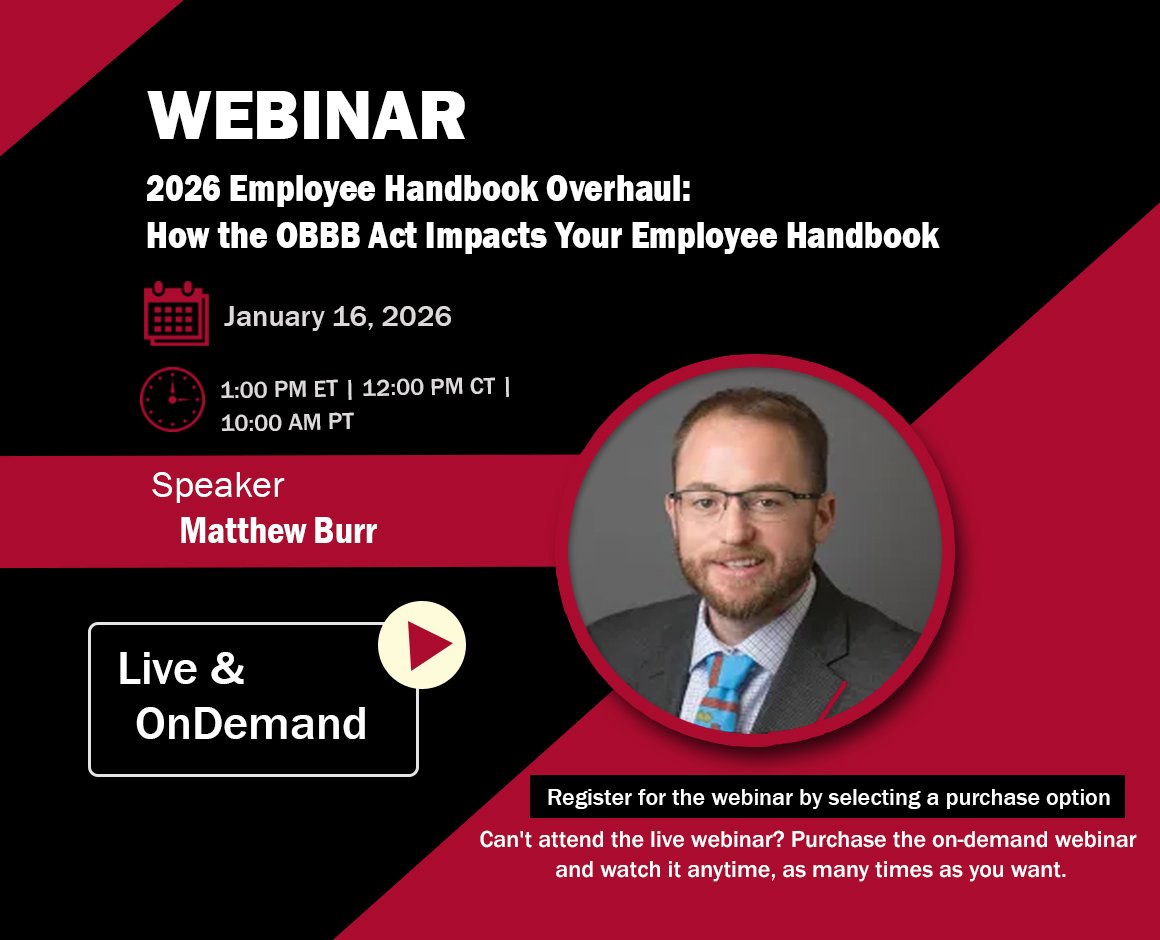
If there was ever a moment to rethink your employee handbook, it’s now. The urgency has less to do with the upcoming 2026 cycle—typically the natural point to introduce a revised handbook—and far more to do with the sweeping workplace changes triggered by the new administration and its updated regulatory agenda, including the recently enacted One Big Beautiful Bill (OBBB) Act.
Signed into law on July 4, 2025, the OBBB Act introduces significant updates affecting employee benefits, payroll administration, and employer compliance obligations. To remain aligned with federal requirements and ensure organizational readiness, your employee handbook should be updated to reflect the following key changes:
- Tip and overtime tax deductions: For tax years 2025 through 2028, the OBBB Act creates new, temporary federal tax deductions for eligible employees.
- Tip deduction: Employees in customarily tipped occupations can deduct up to $25,000 in qualifying tips from their federal taxable income.
- Overtime deduction: Employees can deduct up to $12,500 of qualified overtime premium pay from their federal taxable income ($25,000 for joint filers).
- Employer reporting: You must update payroll systems to separately track and report both qualified tip and overtime pay on employee Form W-2s. Your handbook should clearly explain that these earnings are still subject to Social Security, Medicare, and state taxes.
Beyond the OBBB Act, you should also consider other updates for 2025:
- Remote and hybrid work policies: Formally document expectations for working hours, communication, equipment use, and security for remote and hybrid employees.
- Artificial intelligence (AI): Establish clear guidelines for using AI in the workplace, including which tools are approved and for which tasks.
- Updated paid leave laws: Check your local and state laws, as many jurisdictions are implementing new requirements for paid sick and family leave. For instance, California has new sick leave provisions for 2025.
- Anti-harassment and inclusion: Ensure your anti-harassment and anti-discrimination policies reflect current legal guidance and include a clear, accessible reporting procedure. Using inclusive language throughout the handbook is also recommended.
- Employee classification: Revisit rules on overtime exemptions, particularly in light of recent court rulings and increased salary thresholds. Some states also have their own minimum salary requirements.
Federal, State, and Local regulations are in place, and regulatory agencies are revving up audit focus for 2025 and beyond. For example, Immigration Enforcement requirements. Many state regulations and multi-state regulations are impacting which laws supersede federal regulations.
Workers’ new expectations may clash with employers’ old policies. Policies that ban flexibility, certain policies, as per the temporary and permanent changes in the workplace.
Why You Should Attend
The OBBB Act is not the only change we will need to adjust to our Employee Handbooks. Federal regulations are not the only changes that are expected. We have learned that State regulations have superseded the Federal regulations because the regulation with the most benefit for the employee supersedes them. Many states have several changes that impact employees in state-specific and multi-state locations. When you add remote workers, there are many changes that have to be in place where compliance is key. Is your employers ready for the 2026 Employee Handbook updates?
Areas Covered
- Participants will learn, identify, and prepare for employee handbook violations.
- Participants will learn what policies need to be added to their employee handbook now that the OBBB Act is law
- Participants will be aware of all the new regulations that will impact their company.
- The course will identify the most common employee handbook violations and how to mitigate them.
- Learn how the Department of Labor (DOL), and the Equal Employment Opportunity Commission (EEOC) adapted to the changes based on the results of the OBBB Act
- Learn how to change regulations to be compliant with employee handbook policies
- Participants will learn which regulatory agency will focus on which regulation and mitigate the risk
- Participants will learn what policies will land them in hot water if they are not compliant.
- What policies are “must-haves” for your employee handbook?
- Learn how AI will impact the workplace and what guardrails need to be in place to avoid discriminatory perceptions
- Social media and the impact of penalties when employees choose to speak negatively about their Employer.
- Learn how your managers/supervisors can be your ambassadors in workplace compliance or your downfall
- See how training can be one of your “first line of defense” in litigation.
Who Should Attend
- All Employers
- Business Owners
- Company Leadership
- Compliance professionals
- Payroll Administrators
- HR Professionals
- Managers/Supervisors
- Small Business Owners
 Edupf is recognized by SHRM to offer Professional Development Credits (PDCs) for the SHRM-CPSM or SHRM-SCPSM. This program is valid for 1.0 PDCs for the SHRM-CPSM or SHRM-SCPSM. For more information about certification or recertification, please portal.shrm.org.
 This Program has been approved for 1.0 HR (General) recertification credit hours toward aPHR™, aPHRi™, PHR®, PHRca®, SPHR®, GPHR®, PHRi™, and SPHRi™ recertification through HR Certification Institute®? (HRCI®).